Company Holiday Party Ideas for Small Teams and Large Groups
Choose company holiday party ideas by team size and budget, with optional games, sample schedules, and an organizer checklist. Build a plan your team can use.
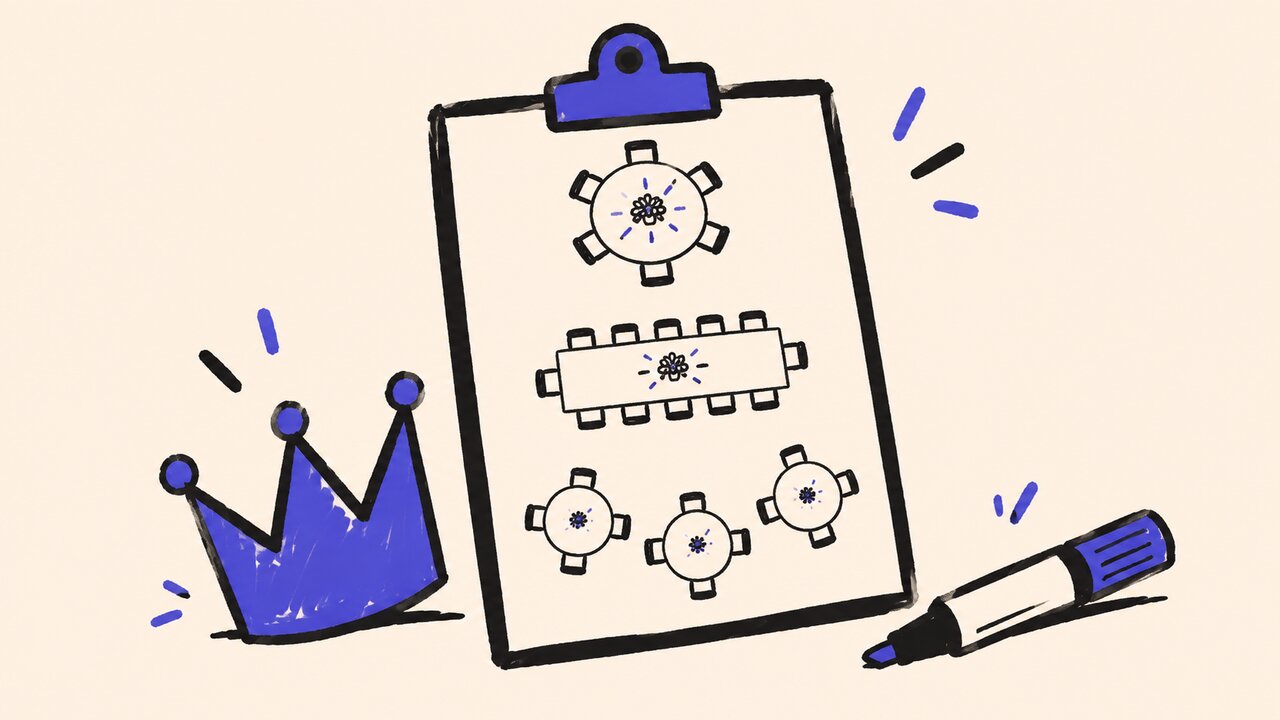
Short answer: Choose company holiday party ideas by the number of people who will attend at once, your complete budget, and employees’ participation needs. Start with a meal and one optional activity, then add entertainment only if the venue, staffing, and schedule support it.
- Small team: A hosted lunch or supper leaves time for conversation without a stage or competition.
- Medium group: Repeat a seated activity at several tables instead of making everyone queue.
- Large workforce: Compare one large gathering with repeated smaller sessions. They solve different problems.
- Remote or shift-based team: Budget for a comparable celebration, not a camera pointed at another group’s dinner.
The company holiday party ideas below are original planning examples, not events we claim to have tested. Dollar amounts are illustrative US allowances, not vendor quotes. Use the printable organizer packet to replace assumptions with your own numbers.
Who this is for (and not for)
This guide is for HR teams and office managers who need a celebration they can explain, cost, and run. It suits:
- A small office choosing between lunch, dinner, and a short creative activity.
- A growing company planning several tables without a professional entertainment team.
- A larger employer considering repeat sessions for shifts or limited room capacity.
- A distributed team that needs an alternative to an in-person-only invitation.
Ask about timing and activity preferences before booking. Provide a private contact for dietary and accommodation requests rather than collecting diagnoses in a shared spreadsheet. A majority vote helps select entertainment; it does not replace access arrangements for individuals.
This is not a production plan for a public festival or client gala. It is also not legal advice about payroll, alcohol service, or accommodation duties. Your venue, HR team, caterer, and relevant advisers need to confirm those details.
Keep attendance, playing games, exchanging gifts, and appearing in photographs separate choices. Someone can enjoy lunch without explaining why they skipped a game. For nonseasonal alternatives, see our office team-building activities .
Choose company holiday party ideas by headcount and budget
Count guests, workers, support people, and venue staff when checking room occupancy. The workforce total is not necessarily the number present at once. These three designs illustrate that distinction.
| Format | Guests | Duration | Illustrative total | Main limitation |
|---|---|---|---|---|
| Postcard supper | 12 | 75 minutes | $716.45 | One host needs a simple service plan |
| Pass-the-puzzle studio | 60 | 120 minutes | $4,220.50 | Preparation and room noise need attention |
| Three-seating social | 180, in groups of 60 | 170 minutes overall | $15,180 | No simultaneous all-company moment |
Small office Christmas party ideas: a postcard supper
Use two tables with six usable guest places each. Budget one paid host for three hours of preparation, hosting, and cleanup, separate from the 12 guests. Order food in advance rather than assigning employees cooking duties.
Allow 10 minutes for arrival, 25 for eating, 20 for optional postcard making, 15 for conversation, and five to close. Put blank cards, broad markers, precut paper shapes, and glue sticks within reach. Invite guests to design a postcard from an imaginary destination. Writing, drawing, dictating, and conversation-only participation all count.
Christmas decorations can suit a team that wants them; they need not determine the activity. Avoid compulsory gifts or costume purchases. If the host must manage complex food service or individual assistance, add staffing instead of assuming one person can cover everything.
Sixty guests: pass the puzzles, not the people
Seat ten groups of six. Prepare one puzzle packet and one creative-exhibit sheet per table, with large-print instructions and accessible electronic copies. Let guests stay seated while a facilitator exchanges materials.
Allow 15 minutes for arrival and meal pickup, 25 for eating, five for instructions, two 20-minute activity rounds separated by a five-minute break, 15 for optional discussion, and 15 for dessert and departure. Budget four workers for four hours each: a lead, a facilitator, and two catering workers. Confirm the food-service staffing with the caterer.
For a service rehearsal, suppose two meal pickup points each handle three meals per minute. Sixty meals would take 10 ideal minutes; the 15-minute arrival window leaves only five minutes of buffer. That assumption needs testing, not a promise about queues. Arrange seated delivery where needed.
A large group: repeat a complete celebration
For 180 employees, run three 50-minute sessions for 60 people, with two 10-minute resets. Each session includes 15 minutes for arrival and food distribution, 20 for eating and optional table art, 10 for sharing or conversation, and five for departure.
Give each table a large sheet and shapes to create an imaginary neighborhood. People can draw, label, dictate, or observe. Photograph the artwork rather than assuming everyone wants a portrait.
The budget assumes 12 workers for five hours: a lead, an access contact, two entry staff, four catering workers, two facilitators, and two floaters. Peak baseline attendance is 72 including these workers, before other personnel or support people. Do not admit the next session until the previous one has left. If everyone must gather together, obtain a different venue and service plan rather than stretching this example.
What the example budgets include
Every figure is an invented allowance. Purchased items assume applicable tax, delivery, and quoted service charges are included. Replace them with itemized quotes and check for missing fees.
| Expense | 12 guests | 60 guests | 180 guests |
|---|---|---|---|
| Meals, including workers and limited spares | $252 | $1,680 | $5,400 |
| Nonalcoholic drinks | $48 | $240 | $900 |
| Materials | $48 | $240 | $540 |
| Venue and furniture | $0, existing office | $250 | $1,800 |
| Delivery/cleanup or AV/signage | $35 | $200 | $600 |
| Operations labor | $90 | $560 | $2,160 |
| Access/transport allowance | $150 | $500 | $1,800 |
| Subtotal | $623 | $3,670 | $13,200 |
| 15% contingency | $93.45 | $550.50 | $1,980 |
| Total | $716.45 | $4,220.50 | $15,180 |
Labor assumptions are 3 hours at $30, 16 hours at $35, and 60 hours at $36, respectively, using hypothetical loaded hourly costs. Meal assumptions are 14 at $18, 70 at $24, and 200 at $27. Spare meals do not replace correctly ordered dietary meals.
These totals exclude guest payroll, substantial advance planning, shift backfill, alcohol, childcare, remote packages, unquoted permits or insurance, and local overruns. Access allowances are not caps on accommodations. Lower spending by simplifying entertainment or using an appropriate existing room, not by removing necessary access or assigning unpaid work.
Optional corporate holiday party games with clear instructions
Pick one activity, not a compulsory circuit. State the finish time, show an example, and offer conversation seating without a game. The following instructions are proposed designs; rehearse them with someone who did not write them.
A six-card puzzle for the studio
For each table, print six exhibit cards labeled Garden, Harbor, Market, Observatory, Studio, Workshop, these clues, and a separate answer sheet. Add a pen, a large-print copy, and an electronic text version.
- Garden is first and Workshop is last.
- Harbor comes immediately after Garden.
- Observatory comes immediately after Market.
- Studio comes immediately before Workshop.
Ask the group to arrange a fictional museum corridor from first to last. The answer is Garden, Harbor, Market, Observatory, Studio, Workshop. Spend two minutes explaining, up to eight arranging, five inventing an exhibit for one room, and five comparing with the answer and discussing. Finish early if the table prefers. There is no speed prize or knowledge test.
For the second 20-minute round, ask the table to draw or describe one exhibit together instead of preparing another scored puzzle. A facilitator can read clues; a participant can direct someone else to move cards. Test table noise and legibility beforehand. Materials fit the studio’s $240 allowance only if your printing and supplies quotes do.
A creative station with an optional 2026 reference
Pixar’s Toy Story 5 production notes describe a tactile, handmade approach to imagined play. That offers a useful creative starting point, not evidence that film-themed office parties are a trend.
Try Invent a Plaything: “Make an original object whose only job is to make someone smile.” Give tables clean cardboard, paper cups, precut shapes, masking tape, and washable markers. Use two minutes for instructions, 10 for making or sketching, five for optional descriptions, and three for a tabletop gallery.
For up to 20 willing participants, start with one facilitator; for more tables, assign a supplies helper and test the workload. Offer dictation or a text-only invention, and keep assistive devices welcome. Nobody needs to know the film, recall childhood experiences, or copy a character. Price a sample kit before expanding; this station is a substitution, not included automatically in every budget above.
Photos without a compulsory photo game
Offer a short optional photo activity using the existing holiday-party photo scavenger-hunt prompts . Select prompts for your setting instead of giving guests the entire bank. Use printed instructions, seated object-only choices, and a shared device if wanted. Assign a host and reviewer; do not promise automatic team scoring. Conversation remains an equally valid way to spend the activity window.
A realistic holiday-party schedule
This separate 90-minute example suits a meal plus one optional activity. It is not the schedule used to calculate all three budgets above. Confirm service capacity and staffing before adopting it.
| Local time | Plan | Owner |
|---|---|---|
| 4:00 to 4:10 | Arrival and seating | Host |
| 4:10 to 4:15 | Welcome, access notes, optional-activity reminder | Host |
| 4:15 to 4:40 | Meal service and eating | Catering lead |
| 4:40 to 5:15 | Optional activity or conversation | Facilitator |
| 5:15 to 5:25 | Dessert and brief thanks | Host |
| 5:25 to 5:30 | Departure buffer | Host |
The 35-minute activity block includes three minutes of explanation, 25 for participation, and seven to finish. A 20-minute craft leaves room for unhurried setup and conversation. Avoid adding speeches to that window after invitations go out.
Setup and cleanup fall outside the 90 minutes. If catering runs late, shorten or remove the activity rather than taking away eating time or extending the advertised finish. Arrange a separate remote host and captioned session, or an asynchronous alternative with comparable materials and food support. Repeated shift celebrations can use the same instructions, but staffing and payroll decisions still need their own approval.
Organizer checklist from invitation to cleanup
Use the printable checklist and schedule to assign owners. Keep sensitive request details outside that shared worksheet.
- Before booking: Confirm headcount per session, total spending ceiling, venue layout, access needs, shifts, and timing preferences. Hanukkah in 2026 begins December 4 at sundown and ends December 12 at nightfall. This is one calendar consideration, not a complete list of employee constraints.
- Before invitations: Explain attendance and activity choices, food arrangements, photo uses, and a private request contact. Follow the ADA National Network’s accessible-event planning guidance : inspect routes and facilities, not merely the venue’s accessibility label.
- Before food orders: Obtain ingredient information and discuss cross-contact procedures with the preparer. Confirm dietary meals and substitutions. The FDA Food Code 2026 is a model for jurisdictions to adopt, not automatically your local law. Ask the caterer which local requirements apply.
- Before the event: Assign hosts, catering contacts, access support, photo review, remote facilitation, and emergency responsibilities. Test instructions, meal flow, audio, and network access. Do not assume “optional” means unpaid: the Department of Labor’s hours-worked guidance explains why required duties and work performed matter. Ask payroll about attendance and assigned work.
- At closing: Confirm departures, cleanup, vendor returns, and invoices. Share only permitted photos, handle removal requests, and ask what employees would change next time.
How Gather Shot fits into this
Gather Shot is a photo sharing platform for events. For company events and holiday parties , it provides one QR code or link for browser-based uploads without an app or guest account. Optional consent and required guest-data settings can add steps.
Assign a reviewer and require approval before public display. A live slideshow needs Public Gallery enabled and an internet-connected browser display. Approved photos are picked up about every 15 seconds, after your review, rather than appearing instantly. Public Gallery is link-accessible; do not describe it as an employee-authenticated intranet. Skip public display when that audience is inappropriate.
Consent settings can record the uploader’s acceptance of your terms. They do not establish permission from everyone pictured or authorize every later use. Tell people whether photos are for the party screen, an internal recap, or external marketing, and confirm permissions separately.
Uploads need internet. With poor reception, guests can take photos normally and manually upload later while your upload window is open. For a company that prohibits event photography, paper activities are enough. Our corporate event photography guide covers the broader photo-planning decisions.
Frequently asked questions
What are inexpensive office Christmas party ideas for a small team?
Start with a meal in an appropriate existing room and one optional paper activity. Compare the full quote, including delivery, staffing, and dietary arrangements, before adding decorations or gifts. The 12-person example is an allowance-based worksheet, not a minimum price.
Which format works for a large company holiday party?
Choose between a simultaneous gathering and repeated complete sessions. Repeated sessions reduce peak attendance but remove the all-company moment and require resets. A large simultaneous reception needs its own venue, service, and staffing plan.
Do all employees need to join Christmas-themed activities?
No activity should require a personal explanation for declining. Offer a tradition-neutral alternative and communicate choices in advance. Ask HR about accommodation responsibilities; calling attendance optional does not replace accessible planning.
How can remote employees participate without watching other people eat?
Provide a separate hosted activity or asynchronous option, accessible instructions, and comparable food or materials support where feasible. Check time zones and delivery availability. Budget for that arrangement explicitly rather than assuming the room livestream covers it.
Can employees participate without a phone or appearing in photos?
Yes. Supply printed instructions, shared materials, seated roles, and conversation-only seating. Photo activities can use objects rather than people. A colleague can direct a composition without holding a phone or agreeing to be photographed.
How many people should help run the party?
Assign responsibilities first, then check workloads. Hosting, food service, access support, remote participation, and photo review can overlap at busy moments. The example staffing levels are assumptions to test with your venue and caterer, not universal ratios.
Summary and next steps
Shortlist company holiday party ideas only after you know attendance per session, employee needs, and the spending ceiling. A smaller program that finishes on time can be a better fit than a packed agenda with no room to eat or talk.
Use the organizer packet to move from an idea to an approval-ready plan. Replace each allowance with a quote, record what the quote excludes, and name a person responsible for every event-day task. Confirm the access arrangements and service flow before sending a final invitation. For the 180-person example, make the three seating times explicit so nobody expects one large reception.
Then choose one optional activity and rehearse its instructions. Keep remote and shift alternatives visible in the budget. If you want photo sharing, test a QR-code upload and your review settings at the venue before printing signs. After the celebration, review permissions before sharing a recap and retain only what your organization needs under its own policies.
Written by
Gather Shot TeamThe Gather Shot team writes guides, planning resources, and product updates that help event hosts and photographers collect guest photos without asking anyone to download an app.
Related articles
More practical guides selected from the same event photo sharing topics.
Halloween Photo Scavenger Hunt: 30 Prompts
Plan a Halloween photo scavenger hunt with 30 prompts for parties, offices, and neighborhoods, plus setup, safety, team formats, awards, and QR sharing.
Aug 17·14 min read
Company Picnic Ideas for Employees and Families
Use these company picnic ideas to plan family-friendly food, games, team bonding, and photo moments without overloading employees or your planning team.
Jul 2·8 min read
The Best Way to Host an Event and Collect RSVPs
Learn the easiest way to host an event and collect RSVPs with Mixily, a free ad-free RSVP platform. Plus tips for collecting event photos with Gather Shot.
Mar 31·8 min read