Friendsgiving Games for Adults: A Dinner Menu
Plan Friendsgiving games for adults before, during, and after dinner. Get low-prep rules, a short photo challenge, and a printable game menu for your table.
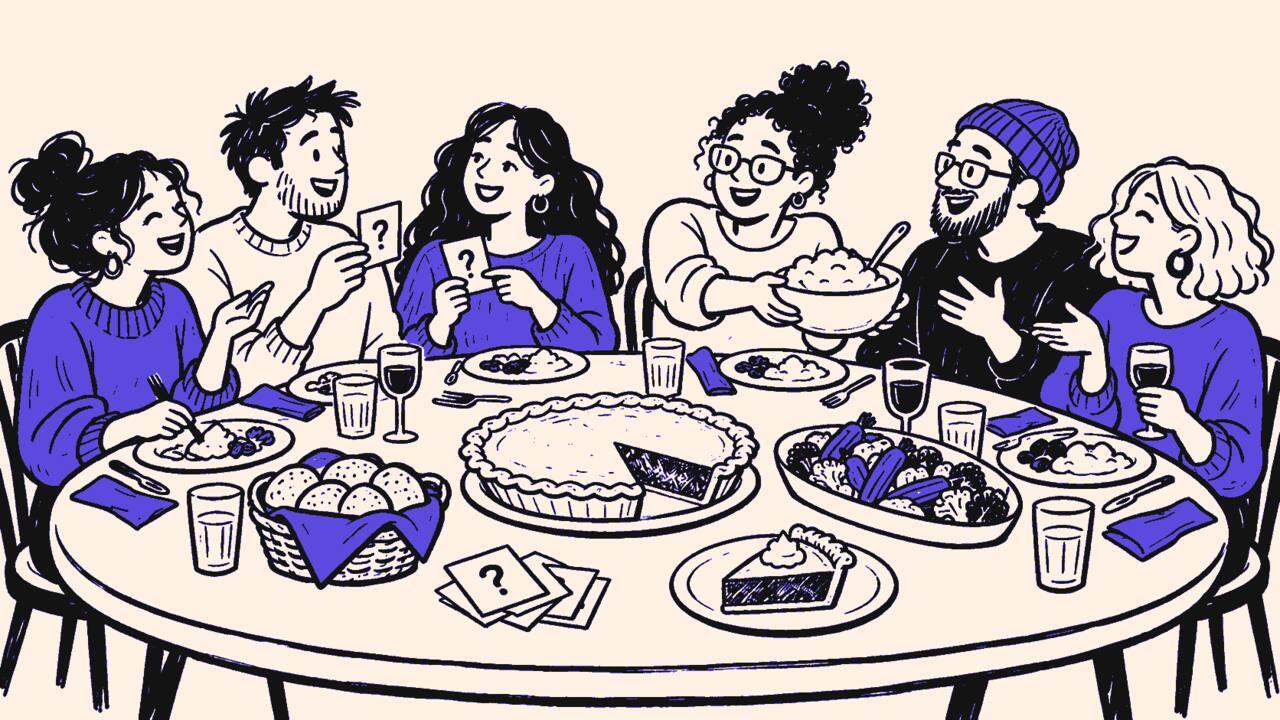
Short answer: Choose Friendsgiving games that fit the pauses around dinner: a cooperative paper puzzle before food, an optional prediction round between courses, and a short mystery or photo challenge afterward. Pick two activities, keep passing welcome, and let good conversation replace any game.
- Before dinner: Solve a table-card puzzle or build a three-song sequence without music trivia.
- During dinner: Save the two-question prediction game for a genuine pause between courses.
- After dinner: Try a fictional mystery or turn a seated object photo into a guessing postcard.
- For the host: Download the printable game kit , including a one-page menu, rules, cards, and answers.
The useful part of Friendsgiving games for adults is not filling every minute. It is having something ready when the first guests arrive, the oven needs ten more minutes, or a few friends linger after dessert. These original house-game proposals need paper, pens, and optionally one camera per small group. Their timing is a planning allowance, not a playtest result.
Who this is for (and not for)
Use this menu for:
- Four to twelve adults sharing a casual dinner.
- Small apartments where everyone needs to stay seated.
- Friends who do not share the same shows, music, or inside jokes.
- Hosts who want a guest to run the activity while they finish cooking.
It is not a drinking-game itinerary, a competitive tournament, or an excuse to interrupt dinner. If your guests prefer uninterrupted conversation, leave the cards out as an invitation rather than calling everyone to attention. A formal event with a facilitator needs a different plan.
Ask about access needs beforehand. Cornell’s accessible-event checklist recommends advance materials, larger print, spoken descriptions, and clear pathways. Here, that means reading cards aloud, accepting pointed or dictated answers, lowering background music, and keeping supplies within reach. Ask what works for the individual rather than assuming seated play solves every access need.
Tell guests: “Play, watch, help, or pass. No explanation needed.” Do not require gratitude speeches, family stories, or confessions. For the dishes and sign-up sheet, use our potluck party ideas ; this menu handles activities instead.
Before dinner: Friendsgiving games with an easy stopping point
Set out one activity, not both. A late arrival can join the puzzle discussion or take the next music-card turn. Nobody needs to recover points from earlier rounds.
One Table, Three Conditions
Players: 4 to 6 together; split 7 to 12 guests into two groups of 3 to 6. Materials: Five paper cards, a pen, and a sheet numbered 1 through 5. Time: Up to 8 minutes, including instructions and the answer. This is a gentle warm-up, not a difficult logic test; finish early when solved.
Write Spoon, Napkin, Mug, Candle, Postcard on separate cards. These are labels, not objects to fetch from the kitchen. Put one card in each numbered position so all three conditions hold:
- Mug occupies position 3.
- Spoon sits immediately before Napkin, in numerical order.
- Postcard occupies position 5.
Start with one turn around the group. Each guest may suggest a placement, ask about a condition, or pass. Then discuss and move cards together. Anyone can direct a move instead of reaching. Stop when everyone agrees or after five minutes of solving; read the answer and its explanation. There are no individual points or speed prizes, and two groups do not race.
Answer: Spoon, Napkin, Mug, Candle, Postcard. Spoon and Napkin must occupy 1 and 2: positions 2 and 3 would displace Mug, while 4 and 5 would displace Postcard. Candle takes the remaining position. Cover this paragraph before playing, or use the kit’s separate answer page.
Three-Track Arc
Players: The same group sizes. Materials: Six paper cards and three spaces labeled Arrival, Dinner, Wind-down. Time: About 6 minutes. Finish/scoring: One turn each; no winner or correct musical taste.
This is music sequencing, not name-that-song. Spotify reported in January 2026 that Jam’s daily active users had more than doubled year over year. That is global platform data, not proof that your friends want a listening party. The useful idea here is making a sequence together without requiring accounts or playback.
Use these six imaginary track titles and descriptors: Doorbell Groove (bright, bouncy), Window Seat (gentle, steady), Kitchen Disco (lively, rhythmic), Long Conversation (quiet, flowing), Night Bus (slow, reflective), Second Helping (warm, upbeat).
Place the first three cards in the three spaces. Going around once, each guest may swap two occupied cards, replace one with an unused card, or pass. Offer a brief reason aloud or in writing if desired. After the last turn, read the sequence and finish. Descriptors carry the game for anyone who cannot hear music; no singing, streaming, or song knowledge is necessary.
During dinner: a quiet prediction game between courses
Skip this section in real life if conversation is flowing. Friendsgiving game ideas should help a host, not create another schedule to enforce. Wait until participants have finished eating and the next course is not arriving. Put pencils away as soon as serving resumes.
Supper Forecast
Players: 4 to 12 invited, at least two voters per round. Materials: Paper and pens. Time: Two rounds of 60 to 90 seconds each. Rules: Each player privately writes both a choice, A or B, and a prediction of the group’s result, A, B, or tie.
Read these fictional questions, one per round:
- Your imaginary neighborhood restaurant has one spare room. Should it become A: a listening lounge or B: a board-game library?
- A fictional midnight diner needs an opening-night special. Should it offer A: breakfast at dinner or B: a dessert tasting menu?
Reveal all votes and predictions together. Count only votes cast, including each voter’s own. Award one point for correctly predicting the majority or a tie, then repeat with question two. Stop after two rounds; highest totals share the win. If serving interrupts an unrevealed round, discard it. A completed first round can stand alone.
Guests may leave a round blank or privately dictate their answer to a nonvoting helper. Nobody has to defend a preference. An odd-sized group can still tie when someone passes, so keep “tie” on the prediction slip. Void any round with fewer than two votes.
After dinner: a mystery or a short photo challenge
Clear plates before putting paper on the table. Choose one of these activities, or offer the second only if people ask to keep playing. Neither depends on attendance at the earlier games.
Second-Clue Supper Mystery
Players: 4 to 6 together; split 7 to 12 into two groups of 3 to 6. Materials: The premise and two clues below, paper, and a covered answer. Time: Up to 8 minutes. Scoring: Cooperative, with no penalty for changing an answer.
NBC’s The Traitors: New Blood had aired by September 2026, according to NBCUniversal’s post-premiere report . This little mystery borrows the pleasure of another reveal, not its rules, characters, or elimination format. Nobody at your dinner plays a liar or becomes a suspect.
Read the premise: “At a fictional dinner, exactly one of three helpers moved a recipe envelope from the mantel to a safe place. Alex left at 6:40, Blair at 6:50, and Casey at 7:00. Each was present until leaving once and never returning. All evidence is true; no other person or explanation is possible.”
Clue one: “A timestamped photo shows the envelope still on the mantel at 6:45. Another shows it gone at 6:55.”
Discuss for two minutes. Record a provisional answer or “not enough evidence.” Reveal those answers, then read clue two: “The helper who moved the envelope had already left by 6:55.” Discuss for two more minutes and record a final answer.
Answer: Blair. The 6:45 photo shows the envelope still present after Alex left. After clue one, Blair and Casey remain possible; clue two rules out Casey. Reveal the explanation even if the group remains undecided. Passing, silent reading, and written observations are welcome. There are no individual scores, accusations, or tiebreakers.
Postcard From This Table
Players: Pairs or trios, each making one entry. For five guests use a pair and trio; for eleven use a pair and three trios. Materials: A camera or sketch paper per group, a clue slip, and a pen. Time: Three minutes to capture, two to write, then up to one minute per group to reveal, plus a minute explaining.
Choose a stationary object visible from your seats. Photograph or sketch it without moving hot dishes, entering private rooms, or including people, reflections, screens, or private notes. A napkin, an empty glass, or a place-setting detail is enough. Keep the image hidden.
Write two clues: one literally true description and one imaginative comparison. For a folded napkin: “I began as a flat square” and “I am the smallest mountain at dinner.” Do not name the object. At a natural pause, read the clues; the other groups each write one guess and reveal together. Show the image or sketch, accept the object type, and move to the next group.
Finish after one reveal per group. There are no points or ties to resolve. Someone can choose the subject, dictate clues, sketch instead of photograph, observe, or skip. Uploading is a separate choice, not a condition of playing. For a longer activity, use the holiday photo scavenger hunt prompt bank instead of extending this short game.
Copy or print your Friendsgiving game menu
Download the Friendsgiving game kit (PDF) . The six-page kit starts with a one-page host menu. The remaining pages contain complete rules, copyable cards, the staged mystery, photo clue slips, and a separate answer key. Print page 1 alone for scheduling; print the relevant rule pages to run the games without this article. The text version is available for copying or enlarging.
| Dinner moment | Choose an activity | Allow |
|---|---|---|
| Arrivals | One Table, Three Conditions OR Three-Track Arc | 8 or 6 minutes |
| Between courses | Supper Forecast, only if wanted | 2 to 3 minutes |
| After clearing | Second-Clue Supper Mystery OR Postcard From This Table | 8 minutes, or 6 minutes plus 1 per group |
Copy into your invite or host notes:
We have a few optional paper games for Friendsgiving. You can play, watch, help, or pass without explaining. We will stop for food. Photo-game entries can be sketches, and sharing images afterward is optional.
Arrival activity: ______. After-dinner activity: ______. Guest helping run the games: ______. Supplies ready: ______. If sharing photos, who can see them: ______.
Set the answer sheet aside before guests arrive. Give a co-host the rule pages so cooking does not depend on you also reading clues. These timings are flexible caps, not promises about how long every group will need. There is no evening-long score to maintain or prize to buy.
How Gather Shot fits into this
Gather Shot is a photo sharing platform for events. It is optional here: paper instructions and camera rolls are enough to play the photo-postcard game. Use Gather Shot when you also want a place to collect the images after the reveal, rather than asking everyone to send them separately.
With Gather Shot photo collection , guests scan an event QR code and upload through their browser without downloading an app or creating a guest account. Optional consent, email, or guest-data settings can add steps. Check your setup before inviting uploads, and explain who will see the gallery.
Keep postcard clues on paper and hold the photo reveal before uploading if guests can view the gallery. The host runs the game; an upload is not a guess, score, or permission to reuse someone’s image publicly. Ask separately before sharing outside the gathering. Uploads require an internet connection, so unreliable Wi-Fi is a reason to collect later while the upload window remains open.
For alternatives and setup choices, see our party photo sharing guide and the holiday-party photo workflow . A single borrowed camera may be all a small dinner needs.
Frequently asked questions
How many Friendsgiving games should I plan?
Choose one arrival activity and one after-dinner activity, with the prediction game as an optional backup. This is a manageable starting menu, not a rule that every gathering needs three games.
Which games work with five or eleven guests?
Five can solve together; eleven can split into groups of five and six. For the postcard game, use pairs and trios. Do not award compensating points or compare group speed: those activities are cooperative or unscored.
Can we play without phones or Wi-Fi?
Yes. The puzzle, music cards, prediction game, and mystery use paper. Sketch an object for the postcard game. If you later choose to upload photographs to Gather Shot, you will need an internet connection.
What if people do not want to perform or share personal stories?
These activities use fictional situations and objects rather than personal revelations. Read the cards aloud, accept written or dictated contributions, and let anyone observe or pass. Nobody needs to explain why they are skipping a turn.
Do we need to buy a game or use Gather Shot?
No. The printable kit and instructions work with ordinary paper and pens. Gather Shot is an optional way to collect photos after the reveal, not a requirement for playing or judging a game.
Are these the most popular Friendsgiving games of 2026?
No. These are original house-game proposals, not a popularity ranking. Eventbrite’s 2026 research discusses lower-pressure socializing, but its survey covers US and UK adults aged 18 to 35 and its platform comparison uses 2024 to 2025 data. It does not measure these games or all US adults.
Summary and next steps
Start with the room and the meal, then choose Friendsgiving games that fit. A paper puzzle before dinner and one postcard reveal afterward make a complete plan. You do not need a game during dinner, a winner at every stage, or a camera pointed at every guest.
Before sending the invite, ask about access needs and identify a guest who can help read instructions while you cook. Print the selected rule pages, cover the answers, and put pens where people can reach them. Keep the menu visible so guests know what is available without feeling enrolled in an evening of activities.
After the photo reveal, ask whether participants want to share their images. If they do, choose one collection destination and tell everyone who can view it. If they do not, let the game end with the reveal. A good memory does not need to become a public post. The useful finish is guests leaving with a pleasant evening, not a completed score sheet.
Written by
Gather Shot TeamThe Gather Shot team writes guides, planning resources, and product updates that help event hosts and photographers collect guest photos without asking anyone to download an app.
Related articles
More practical guides selected from the same event photo sharing topics.
Company Holiday Party Ideas for Small Teams and Large Groups
Choose company holiday party ideas by team size and budget, with optional games, sample schedules, and an organizer checklist. Build a plan your team can use.
Oct 6·14 min read
Thanksgiving Photo Scavenger Hunt for Families
Run a Thanksgiving photo scavenger hunt with recipe memories, old-photo recreations, seated and no-camera options. Get the printable family activity sheet.
Oct 6·13 min read
U.S. Open Tennis Party: Food, Drinks, Decor & Games
Plan a U.S. Open tennis party with Honey Deuce drinks, a mocktail recipe, easy food, games, themes, decorations, invitation tips, and a host timeline.
Aug 19·13 min read